
Stretch marks
Stretch marks after pregnancy, after a growth spurt or after intensive training will not fade on their own, but they can be clearly softened and evened out. At your consultation we will assess whether they are fresh (red) or older (white) — that determines the method and how quickly results appear. We will match the therapy to your skin.
Stretch marks — what they really are
Stretch marks (striae distensae) are linear scars that form deep in the skin when it is stretched rapidly — in pregnancy, during puberty, with rapid weight gain or loss, during intensive training or under the influence of hormones. Collagen and elastin fibres are broken and remodelled, accompanied by inflammation.
Because these are intradermal scars, we speak honestly about their clear softening and evening out, and not about their complete disappearance. We work on remodelling the skin: with a fractional laser, microneedling radiofrequency, microneedling and carboxytherapy. We match the method to whether the stretch marks are fresh and red or mature and white.
See the details
Why the phase of a stretch mark matters most
Fresh, red stretch marks (striae rubrae) still have a blood supply and are inflamed — they respond to treatment best, so it is worth not putting it off. White, mature stretch marks (striae albae) require genuine collagen remodelling, so we turn to a fractional laser or Vivace microneedling RF. We establish this distinction at your consultation, and it determines the plan and how quickly results appear.
Experience in working with stretch marks
We have several technologies that work on stretch marks — which lets us match the method to the phase and the area, and not the other way round.
Source: Versum and Booksy reports, as at 30.06.2026 (total stretch mark treatments performed; client numbers and return rates — data for the whole clinic).
Where stretch marks come from
Rapid stretching of the skin
Pregnancy, a growth spurt, rapid weight gain or fast muscle growth exceed the elasticity of the skin.
Hormones
Hormonal fluctuations (pregnancy, puberty) and steroids weaken the collagen structure, making stretch marks easier to form.
Predisposition
A tendency to stretch marks can be inherited — in some people the skin tears more easily despite preventive care.
Identify your type of stretch marks
Red / purple (fresh)
Striae rubrae — vascular, inflamed, young. They respond to treatment best; the earlier the better.
White (mature)
Striae albae — pale, atrophic, older. Harder work; they require collagen remodelling and patience.
Mixed / extensive
Different phases in one area (the abdomen after pregnancy, for example) — these need a plan that combines methods.
We assess the phase and extent of the stretch marks at your consultation — that determines the choice of technology, the intensity and the number of treatments.
Want to soften your stretch marks? Book a consultation — we will assess their phase and choose a method suited to your skin.
Book a consultationRecommended solutions for stretch marks
We have several technologies with different mechanisms — from a fractional laser to carboxytherapy. We match them to the phase of the stretch marks and the area. Each method has its own dedicated page.
Fotona laser stretch mark removal
A fractional Er:YAG remodels the skin layer by layer — softening stretch marks and evening out the texture. A strong option for white and mixed marks.
Vivace microneedling RF
RF energy delivered by needles deep into the skin stimulates neocollagenesis — remodelling the base of the stretch mark.
Dermapen 4
Micro-punctures stimulate collagen and improve the structure — a good complement to stretch mark therapy.
Carboxytherapy
Carbon dioxide improves microcirculation and tissue remodelling — it supports the softening of stretch marks.
A quick comparison
| Method | Works best on | Result | Course |
|---|---|---|---|
| Fotona fractional laser | white and mixed stretch marks | remodelling, softening, texture | a course |
| Vivace microneedling RF | deeper, mature stretch marks | neocollagenesis, tightening of the base | a course |
| Dermapen 4 | fresher, shallower stretch marks | collagen stimulation, structure | a course |
| Carboxytherapy | microcirculation support | nourishment, remodelling | a course |
What the research says about treating stretch marks
The methods we use are supported in the literature. Below are publications on laser and energy-based treatment of stretch marks.
Fractional laser for stretch marks
A study of laser treatment of stretch marks showed an improvement in their appearance and in skin texture after a course of treatments.
Meningaud J-P. et al., 2018 · PubMed →A comparison of laser methods
A paper comparing laser methods (Er:YAG vs dye laser) in stretch marks points to the effectiveness of fractional resurfacing.
Gauglitz G.G. et al., 2014 · PubMed →Mechanisms and treatment of stretch marks
A review of the pathogenesis and treatment methods for striae distensae sets out the effectiveness of the available therapies.
Hendawy et al., 2022 (PMC) · PubMed →Informational and educational material — it does not replace a consultation. Stretch marks are scars; results are individual and depend on their phase and the area.
Stretch mark therapy step by step
Once we have assessed the phase and extent of the stretch marks, we plan a course — often combining several technologies. After treatment the skin may be pink; the result builds gradually and calls for patience, especially with white stretch marks.
Your consultation and assessment
Identifying the phase (red/white), the areas and the goal.
The course plan
Choosing the technologies, the number of treatments and the intervals.
The treatments
Remodelling the skin — laser, microneedling RF, microneedling.
Results and maintenance
Softening and evening out; top-up sessions if needed.
How to support the result and protect your skin
Skin after stretch mark treatments needs support — it improves the result and protects against irritation.
Sun protection
Fresh stretch marks and skin after treatment need SPF 50 — the sun deepens pigmentation.
Moisturising
Regular oiling and moisturising supports the skin’s recovery and elasticity.
No irritation
After treatment skip the sauna, the swimming pool and intensive training for as long as your specialist advises.
Prevention
With a planned pregnancy or changes in weight — moisturising and a gradual pace limit new stretch marks.
Patience and consistency
Results on stretch marks build over a course — keeping to the intervals decides the outcome.
Informational and educational material. Detailed recommendations are given by your specialist; results are individual.
See also
They trusted us
“I have been for my first laser stretch mark removal appointment and I am very pleased!” (translated from Polish)
Marta P. · 2025review from Google“At this clinic a course of treatments got rid of my stretch marks. The result was a very pleasant surprise; I recommend it.” (translated from Polish)
Blanka B. · 2024review from Google“Five treatments were quite enough to get rid of the stretch marks on my stomach after pregnancy. Encouraged by that, I am now considering a body-contouring treatment.” (translated from Polish)
Wercia G. · 2023review from GoogleWhen to take extra care
Stretch mark treatments are always preceded by a medical history. The main contraindications and situations calling for caution:
Stretch marks are scars — we work honestly on softening and evening them out, without promising complete removal.
Frequently asked questions about stretch marks
Does the laser remove stretch marks completely?
Honestly: no. Stretch marks are intradermal scars, so they do not vanish without trace. They can, however, be clearly softened, their colour evened out and the skin texture improved with a course of treatments — most of all in people who start early.
Do the treatments work on white, long-standing stretch marks?
Yes, although it is harder and slower than with fresh ones. White stretch marks require collagen remodelling — they respond best to a fractional laser and microneedling RF over a longer course. The result is gradual.
Is it better to start while the stretch marks are still red?
Yes. Fresh, red stretch marks still have a blood supply and respond to treatment best, so it is worth not putting it off. If they are already white — we can still help, the plan is simply longer.
Which areas can be treated for stretch marks?
Most often the abdomen, thighs, buttocks, hips, breasts and arms. The choice of technology depends on the area and the phase of the stretch marks — we settle that at your consultation.
What does the treatment feel like, and does it need recovery time?
Comfort depends on the method. After a laser or microneedling RF the skin may be pink and slightly swollen for a few days. We use anaesthetic where it is needed and give you aftercare instructions.
How much do stretch mark treatments cost?
The price depends on the technology, the size of the area and the length of the course. We provide a quote at your consultation, and full rates are available in the price list.
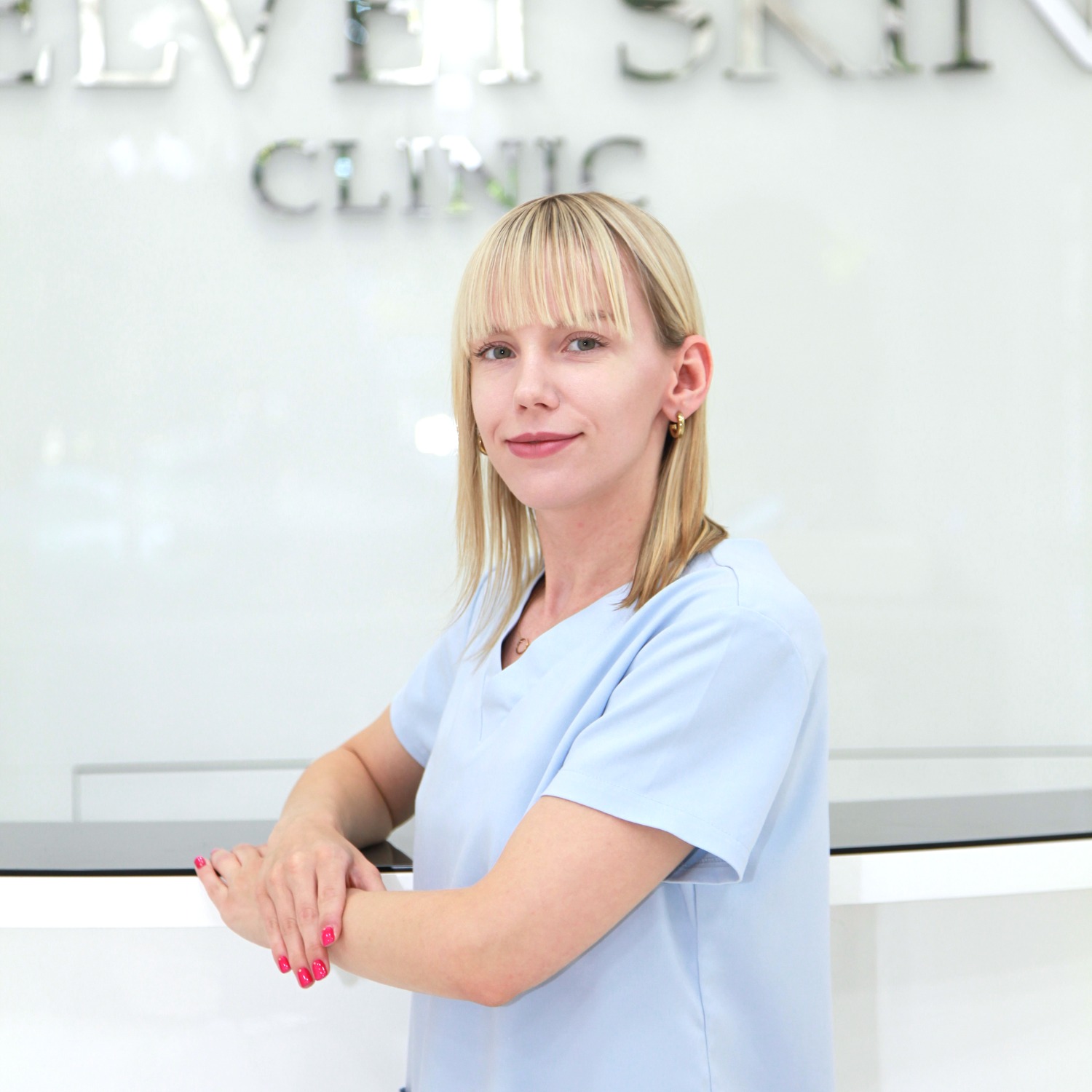
Treatments are performed by our cosmetologists
Treatments at Velvet Skin Clinic are performed by certified cosmetologists with many years of experience in laser therapy, hi-tech devices and skin care treatments. After a consultation we match the method and the specialist to your skin and your goal.





Let us talk about how we can help you — book a consultation
ul. Świętokrzyska 30
00-116 Warszawa · opposite the Palace of Culture and Science
tel. 500 53 30 30
See what the research says
The publications on which we base this offering — with PMID identifiers and an assessment of the strength of evidence.